
The Benefits of Using a Birthing Ball
A birthing ball is a fitness ball that women can use for performing antenatal exercises. You may have heard it called a pregnancy ball, birth ball, or birthing ball. Regular use of a birthing ball can also be considered a labour preperation exercise that can smoothen the birthing process and improve the chances of vaginal delivery. Birth balls are a great addition to your pregnancy kit. It can help you relieve pain and discomfort during pregnancy, labour and even the postpartum phase. They can also be a great addition to your pregnancy exercise program.
In this post, I discuss the benefits of doing birthing ball exercises during pregnancy. A birthing ball should be used under expert guidance,but your midwife, doula, physio, pelvic health or GP can offer support with this. I offer advice about the type of birthing ball you should buy, the ideal size you should use, the right time to start using a birthing ball during pregnancy, and tips on using a birthing ball safely during pregnancy.
First thing's first....when you sit on a birth ball, the hips need to be higher than the knees. It is better to get the right sized ball to start with, depending on your height. Otherwise, the ball can be too small for your height or it regularly needs to be filled with more air. All birth balls usually deflates with time and can be inflated using an air pump.
How to choose the right pregnancy ball:
Size selection guide
When choosing a ball, consider your height. Proper sizing is better for safety and effectiveness.
55cm ball: For heights under 5'4" (163cm)
65cm ball: For heights 5'4" - 5'9" (163-175cm)
75cm ball: If you are taller than 5'9" (175cm), choose a larger ball measuring approximately 75cm
Proper fit test
When sitting on the ball with feet flat on the floor:
• Your knees should be lower than your hips
• Feet should be completely flat, hip-width apart
• You should feel stable and balanced
• The ball should be firm but have slight give
Pregnancy ball types and sizes
Birth balls are round or peanut-shaped. Both shapes help keep the pelvis open and flexible, and provide support when you need it.
Round pregnancy balls
The most popular round birthing balls are made of soft plastic vinyl and are specifically designed not to slide or pop. The round ones look like the big exercise balls you'd find in a Yoga or Pilates studio. One of the great things about a round yoga ball is that it helps you maintain an upright position during labour.
Studies show this can significantly reduce pain and even help your baby get into a better birthing position, which means they can come out sooner.
Peanut-shaped pregnancy balls
Peanut balls are elongated and shaped like a peanut. They're particularly useful during labour when you're lying on your side, as they fit between your legs and help keep your pelvis open. These are especially helpful if you have an epidural and can't move around as easily.
Key features of quality pregnancy balls
• Anti-burst construction: Deflates slowly if punctured rather than bursting
• Non-slip surface: Textured finish prevents sliding
• Durable material: Thick, professional-grade PVC
• Weight capacity: Supports 300+ lbs safely
• Latex-free: Safe for those with allergies
• Easy to clean: Wipeable surface for hygiene
When should you start using a birthing ball?
You can start using the birthing ball as soon as you find out you are pregnant, even during your trying to conceive phase if you're using it for general fitness.
If you're looking to use a ball for lower back pain relief, you'll probably want to start using it sometime between the fifth and seventh month (20-28 weeks).
But back pain can also start before that, so do what's best for you.
You can also start using the ball in the third trimester to gently warm up for labour. Starting early can help you find a favorite position and can also encourage your baby to get into the good positions for labour to start.
Timeline for pregnancy ball use:
First trimester (weeks 1-13): Use for general fitness and comfort if desired
Second trimester (weeks 14-27): Start using for back pain relief and gentle exercise
Third trimester (weeks 28-40): Increase usage for labour preparation and baby positioning
Weeks 37-40: Use intensively to encourage labour and practice positions
Postpartum: Continue for recovery, baby soothing, and gentle exercise
Quality features to look for
• Anti-burst rated: Essential for pregnancy safety
• Non-slip surface: Prevents accidents
• Professional grade: Choose reputable brands like Trideer
• Includes pump: For easy inflation
• Weight capacity 300+ lbs: Supports pregnancy weight safely
• Latex-free: Avoids allergy concerns
What Are The Benefits Of Using A Birthing Ball?
A birthing ball is more than just a fitness tool; it provides physical and emotional support during pregnancy, labour, and postnatal recovery. Here are a few potential benefits of using a birthing ball:
If you’re new to using a birthing ball, starting safely is essential. Proper inflation, stable positioning, and the right exercises prevent discomfort and ensure you get the most benefits. A few simple techniques can help you build confidence while using the ball. Here are a few tips for first-time users of a birthing ball.
Place the ball on a carpet or a rug and not on the floor. Go barefoot, or wear anti-skid shoes. Have someone hold your hand and support you from the back when sitting on the ball for the first time.
Place your feet firmly on the floor to gain your balance. Place one hand on the ball and slowly lower yourself to sit on the ball.
Now, place your hands on the knees and try rocking the pelvis sideways, and back and forth. Once you feel you are comfortable with it, bounce on it a little.
If you are not comfortable with the rocking or bouncing movements, place a chair near you for support.
Make sure that there is enough space around you when you exercise on the ball.
Breathe normally, control your exercise movements, and stop the activity if you experience any pain.
How To Use A Birthing Ball During Pregnancy?
A birthing ball can improve posture, ease back pain, and help prepare your body for labour. Knowing how to sit, bounce, and rock on the ball correctly ensures safety while boosting its benefits for you and your baby. During pregnancy, you can use the birthing ball:
For sitting comfortably when working or resting:
It is much easier to get on and off on the ball than it is to sit on a soft sofa or a hard chair.
Sitting on the ball is also a mini workout. Rocking and bouncing on it gently can keep your tummy and back muscles upright.For some mild exercise:
Birth ball offers the necessary balance, aids in posture improvement, and exercises your abdominal muscles. It gives the required support to help you bear the pregnancy weight.
Rock your pelvis sideways and back and forth while sitting on the ball (pelvic tilts). Hold your core tight, tilt your pelvis back slightly and try curving your lower back gently at the same time. Repeat to strengthen your uterus and lower back. You should not involve your shoulders when doing a lower back stretch, and movement should start from the waist and below.Rotate your hips clockwise and anti-clockwise while sitting on the ball.
Remain in a kneeling position, and then lean over the ball (resting child’s pose). Now rock your hips front to back. This really helps you to relax.
For changing babies position in late pregnancy: How To Use A Birthing Ball During Labour?
Working out on the ball can help with birth preparation, aid in core strengthening, and make you feel comfortable before labour. Sometimes we also recommend using TENS (transcutaneous electrical nerve stimulation, a drug-free option for pain relief) along with the birthing ball to help you cope with early labour.
Here is how you can use the birthing ball during labour:
1. Sit on the birthing ball with your feet shoulder-width apart. Now rock your pelvis side to side and from front to back (like using hula hoops). This helps to stretch out your body so that the baby can move into the right birthing position.
2. Get onto all your fours by hugging the ball, and gently lift your bottom from a kneeling position called the resting frog squat. Rock your pelvis sideways.
3. Lean forward over the ball while standing, with the ball placed on the bed or an elevated platform. This labour ball position gives gravity needed for the baby’s descent.
4. Bouncing gently on the ball strengthens your legs and improves your ability to balance. It is also helpful in giving counter pressure you require during labour.
5. If you are worried about falling off the birthing ball, consider seeking balance training, or try sitting upright on the peanut ball, an alternative to the rounded birth ball.
6. Lie on your side using a peanut ball. It helps you rest and sleep well. It also keeps your pelvic region open when resting.
8. Peanut balls are elongated and shaped like a peanut. They're particularly useful during labour when you're lying on your side, as they fit between your legs and help keep your pelvis open. These are especially helpful if you have an epidural and can't move around as easily.
Do pregnancy balls work?
During pregnancy and labour, many times a birthing ball is just what you need. The science backs this up with impressive results.
Pregnancy period:
A key reason for using a birth ball during pregnancy is to help reduce lower back pain - which occurs in about 70% of pregnancies.
In this study of women who were 20 to 22 weeks pregnant, a 12-week stability ball exercise program helped reduce back pain and improve health.
So does that mean you have to be on an exercise program to reap the full benefits? No! Simply sitting on your ball is also very beneficial.
Finding a comfortable seat can become more of a challenge as your belly grows. Sitting on a birthing ball instead of a chair can help you find a comfortable position and make it easier to get up and down.
Additional pregnancy benefits
• Improves posture: Naturally encourages proper spinal alignment
• Strengthens core: Gentle engagement of abdominal muscles
• Reduces swelling: Promotes better circulation
• Relieves pelvic pressure: Distributes weight more evenly
• Helps baby positioning: Encourages optimal fetal position
• Provides gentle exercise: Safe way to stay active
During childbirth:
Using pregnancy ball during labour
Birth balls can have a positive impact on labour, from the first contraction to the last exertion.
Research shows that birthing balls can help labour progress, manage pain and anxiety, and improve the labour experience. In addition, birth balls may also prevent emergency C-sections.
Specific labour benefits
• Reduces pain: Natural pain management without medication
• Shortens labour: Can reduce labour time by up to 90 minutes
• Improves baby positioning: Helps baby descend and rotate
• Reduces anxiety: Movement and control reduce stress
• Lowers C-section risk: May reduce need for surgical delivery
• Allows mobility: Stay active even with epidural
• Opens pelvis: Upright positions maximize pelvic space
In the postnatal stage:
Postnatal use of a pregnancy ball
Here's one surprising thing your newborn might love: bouncing gently on the birthing ball. Hold them close or wear them in a harness, make sure their head is well supported, and gently bounce while sitting on the ball to help calm them down and even encourage them to fall asleep.
In the early postnatal period, sometimes called the fourth trimester, your pregnancy ball is also a great way to gently stretch your muscles and help support your body as you recover.
Postnatal benefits
• Soothes fussy babies: Gentle bouncing calms crying newborns
• Comfortable seating: Easier on sore perineums than hard chairs
• Gentle stretching: Helps reduce postnatal tension
• Core recovery: Safe way to rebuild strength
• Nursing support: Comfortable position for breastfeeding
• Pelvic floor recovery: Gentle exercises restore muscle tone
Safety Notes:
Always be aware of your body and how you feel. If it hurts, stop.
Also, in order not to slip around, it is best to use the ball on a carpeted floor. Avoid wearing socks if possible bare feet or non-slip shoes are safest.
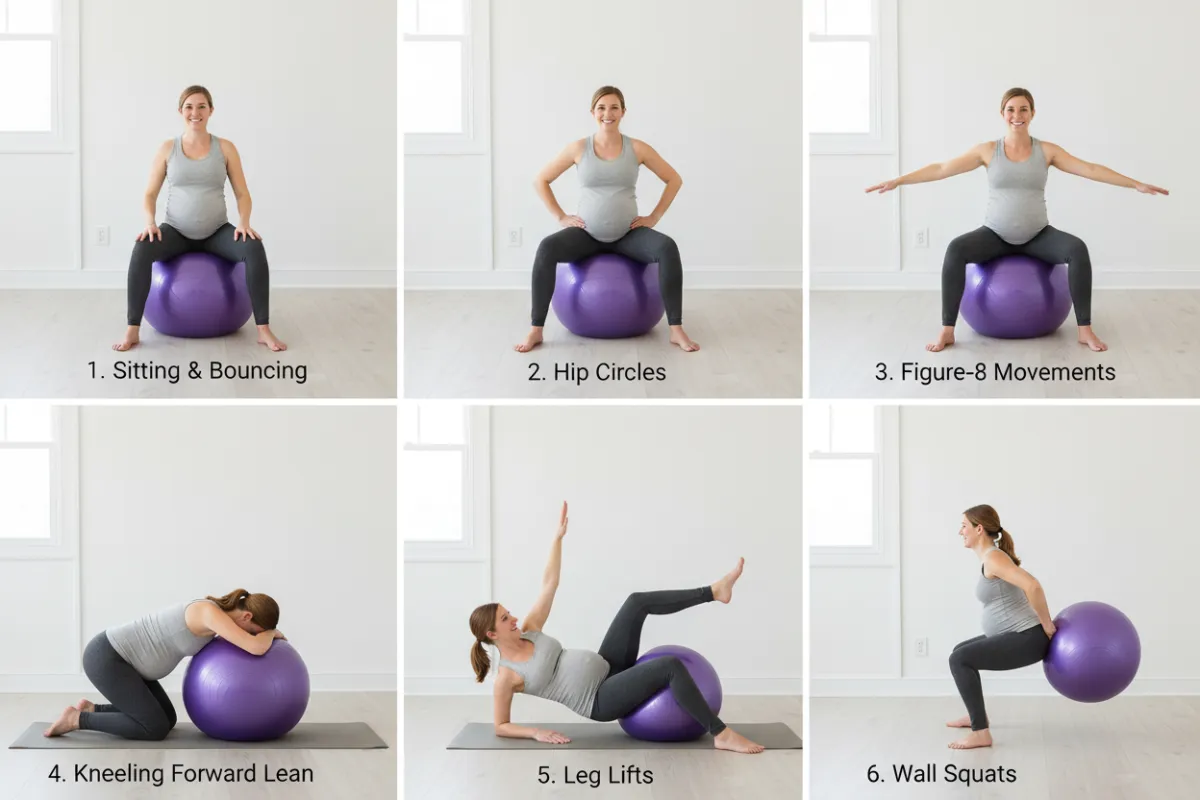
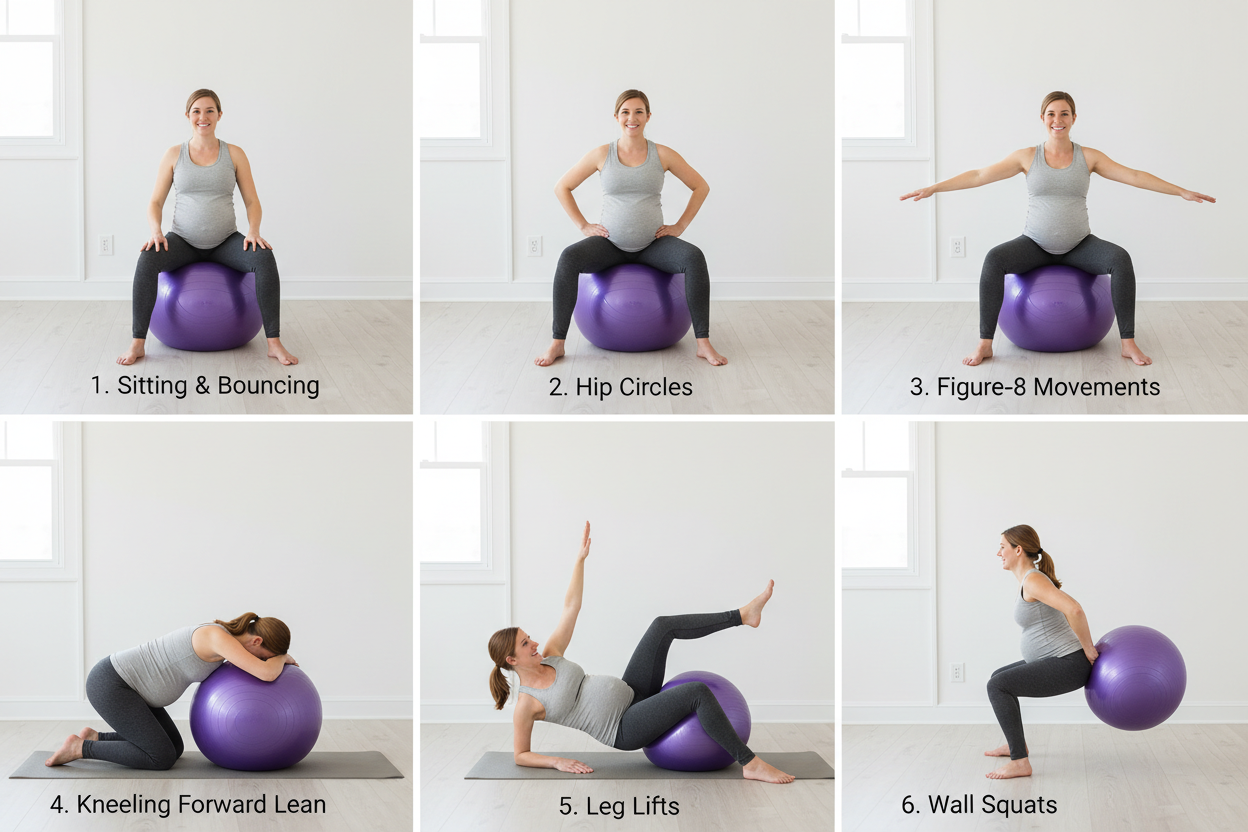
Here are some poses to try
1. Sitting easy
How to do it: Sit on a ball with feet hip-width apart and knees lower than hips. There you have it - your new chair!
Benefits: Improves posture, engages core gently, provides comfortable seating
Duration: Use as your primary seat while working, watching TV, or reading
When: Any time during pregnancy
2. Swing (side-to-side rocks)
How to do it: Sit on your ball and move your hips side to side to increase flexibility.
Benefits: Stretches hip muscles, relieves tension, improves pelvic mobility
Duration: 2-3 minutes
Repetitions: Rock gently 10-15 times each direction
3. Infinity (figure-8 movements)
How to do it: Sit on your ball and move your hips in an infinity or figure-of-eight pattern.
Benefits: Excellent for pelvic flexibility, helps baby positioning, relieves lower back
Duration: 2-3 minutes
Repetitions: 10-15 figure-8s in each direction
4. Circle and circle (hip circles)
How to do it: Sit on the ball and move your hips in a circular motion. Try clockwise, then counterclockwise.
Benefits: Opens pelvis, encourages baby to descend, relieves hip tension
Duration: 2-3 minutes
Repetitions: 10-15 circles in each direction
5. Bow to the ball (kneeling forward lean)
How to do it: Kneel on the ground and let the ball be in front of you. Keep your knees apart and lean your arms forward, resting your head on the ball. Now, gently rock your lower body back and forth.
Benefits: Relieves back pressure, encourages optimal baby positioning, provides rest
Duration: Hold for 1-3 minutes or as comfortable
When: Especially helpful in late pregnancy and during labour
6. Lifts (seated leg lifts)
How to do it: Sit on your ball, raise your arms, then lower them. Then lift one leg at a time, hold, and release. Switch sides.
Benefits: Improves balance, strengthens core and legs, enhances coordination
Duration: 5-10 minutes
Repetitions: 8-10 lifts per leg
7. Squats with ball support
How to do it: Squat! Stand up straight and rotate your feet out to the sides. Place your hands on the ball for balance. After maintaining your balance, squat down with your back straight. You can also try wall squats with the ball against the wall. Spread your legs and squat down slowly.
Benefits: Strengthens legs, opens pelvis, prepares for labour positions
Duration: Start with 5 squats, build to 10-15
Important: Keep back straight, don't squat too deep if uncomfortable
Additional safe exercises
Pelvic tilts: Sit on ball and rock pelvis forward and back
Gentle bouncing: Small, controlled bounces to engage pelvic floor
Arm circles: While sitting, circle arms to improve upper body flexibility
Seated marching: Lift feet alternately while sitting for gentle cardio
Pregnancy ball positions during labour
If you're sitting on your round birthing ball, it helps keep your body relaxed by moving your hips back and forth, side to side. You can also lean on the ball from a kneeling or standing position. If you choose standing, place your ball on higher ground. You can also choose to put the ball on the bed and lean on it.
Effective labour positions:
1. Sitting and rocking
How to use: Sit on the ball and rock your hips during contractions
Benefits: Manages pain, keeps labour progressing, allows movement
Best for: Early and active labour
2. Leaning forward (kneeling)
How to use: Kneel on floor (use cushion) and lean forward over the ball
Benefits: Perfect for back labours, allows partner to massage back, takes pressure off spine
Best for: Back labour, transition phase
3. Standing and leaning
How to use: Stand and lean over the ball placed on a bed or high surface
Benefits: Uses gravity, maintains upright position, provides support
Best for: Active labour, when you want to stay upright
4. Squatting with ball support
How to use: Use ball against wall for supported squatting
Benefits: Opens pelvis maximally, uses gravity, supported position
Best for: Pushing stage, when baby is descending
5. Side-lying with peanut ball
How to use: Lie on side with peanut ball between legs
Benefits: Keeps pelvis open while resting, works with epidural
Best for: Resting between contractions, with epidural
Your Questions Answered:
Q: When should I start using a pregnancy ball?
A: You can start anytime during pregnancy, but most women find it most beneficial starting in the second trimester (around 20 weeks) for back pain relief and in the third trimester for labour preparation.
Q: Can a pregnancy ball induce labour?
A: It won't induce labour if your body isn't ready, but it can help encourage labour to begin naturally when the time is right by promoting optimal baby positioning and cervical changes.
Q: What's the difference between a pregnancy ball and an exercise ball?
A: They're essentially the same! Pregnancy balls are just exercise balls marketed for maternity use. Just ensure it's anti-burst quality and the right size.
Q: How long should I sit on the ball each day?
A: Start with 10-15 minutes and gradually increase. In late pregnancy (37+ weeks), you can use it as much as feels comfortable - many women use it for hours daily.
Q: Is it safe to use a pregnancy ball in the first trimester?
A: Yes, it's generally safe for gentle sitting and light exercise. However, always consult your doctor first if you are worried, especially if you have any complications.
Q: Can I use the ball if I'm having twins?
A: Generally yes, but consult your healthcare provider first as twin pregnancies have special considerations. You may need to modify exercises and be extra cautious.
Q: Will the ball help turn a breech baby?
A: While not guaranteed, certain positions on the ball (like leaning forward) can encourage baby to move into optimal position. Discuss with your Midwife about specific exercises for breech positioning.
Lean forward on the ball and try to get on your knees. Forward-leaning positions while on the ball will help the baby adopt the upright birthing position.
This will make the baby move into the anterior position, with their back towards your tummy.
Though the baby is not going to remain in the same position until labor, exercising on the ball can at least offer you some relief from back pain.
Q: Can I use the ball after a C-section?
A: Yes, but wait for your doctor's clearance (usually 6-8 weeks or longer). Start very gently with sitting only, avoiding any movements that strain your incision.
